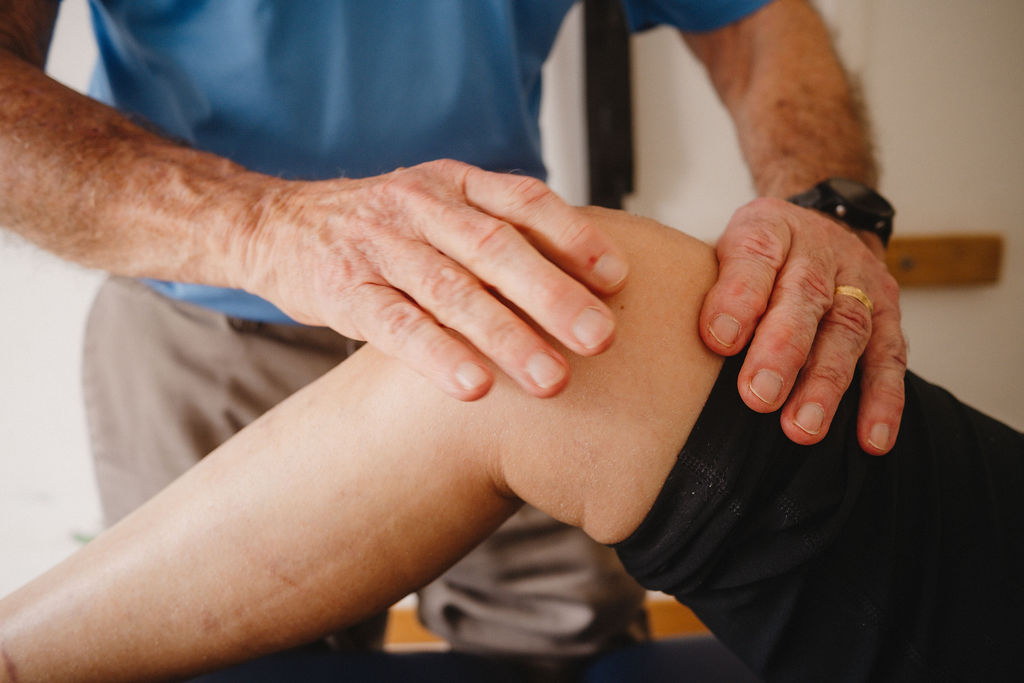
IT Band Syndrome (Lateral Knee Pain)
Dr. Google says you have an IT band problem. Fine — that is a starting point. The real question is WHY. Is the glute medius on that side weak? Is the opposite calf tight? Is the hip flexor short? Is the other knee changing how you load this one?
Rolling the band feels productive and rarely fixes it. The band is being pulled on by structures above and below it. We treat the reason it is under tension.
What It Feels Like
- Sharp or burning pain on the outside of the knee, often at a predictable point in the run
- Worse running downhill, on a cambered road, or on a track in one direction
- Pain that shuts the run down and then feels fine walking
- Occasional tenderness higher up the outside of the thigh or hip
Why It Happens
- Glute medius weakness allowing hip drop and knee drift
- Short or overactive hip flexors changing how the thigh tracks
- Restricted ankle or calf on either side shifting load across the pelvis
- Patellofemoral problems on the opposite leg overloading this one
- Volume, camber, or downhill exposure added too fast
The Evaluation
What We Check In Person
55 minutes, one-on-one, hands-on. No dividing attention between three patients, and no spending most of the hour on exercises you could have done at home.
- Single-leg loading tests to see the hip drop and knee drift in real time
- Hip, knee, and ankle mobility compared side to side
- Glute medius, glute max, and hip flexor strength and length testing
- Manual assessment of the lateral structures, TFL, and vastus lateralis
- Gait observation to find the moment the mechanics break down
Try This At Home First
Start here. If it does not change in two to three weeks, that is the signal you need eyes and hands on it.
Side-lying hip abduction
Slow, controlled, no rolling backward. This is the muscle most often at fault.
Hip flexor lunge with a pelvic tuck
Opens the front of the hip without cranking the low back.
Figure-four glute stretch
Sit back into it and let the posterior hip release.
Single-leg RDL
Builds hip control through the range where the knee usually collapses inward.
This page is general education, not a diagnosis or a treatment plan for your specific injury.
When To Book An Appointment
- The same distance or the same hill stops you every time
- Home work has not changed anything in two or three weeks
- You want to know which side is actually driving it before you keep training
Related Injuries
See all running injuries or browse treatments by body area.